

Legacy Giving Meets its Match: Inspiring the Future Today
Share




One of the biggest challenges in legacy marketing is inspiring a supporter to have a conversation about their vision for the future, about their own legacy gifts or to provide confirmation that a legacy gift has been included in their estate plans. That’s why over half of legacy gifts often come from donors not found in your CRM.
We know that these donors have been deeply moved, touched or inspired to include you in their plans—something that was both inspirational and deeply personal. Yet, they are not giving in traditional ways as a current donor. Are there ways in which we can inspire more people to tell us about their future plans? One strategy was right there the entire time.
Donors love a match!
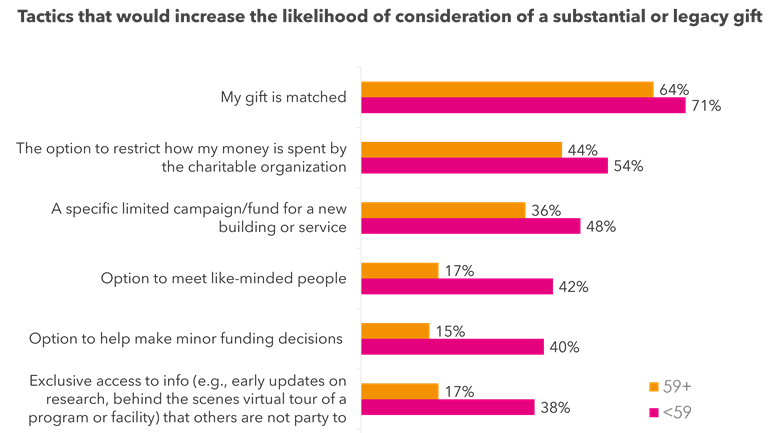
All of the research and donor affinity surveys we have conducted in the past 6 years, show us that matches are the number one way people are inspired to consider a gift or increase a gift. In our latest research, nearly 70% of donors say they’re more likely to give a substantial or legacy gift if a match is on the table. Yet in legacy marketing, matched giving remains an underused tactic. At a time when many planned gifts come from donors we didn’t know we had, how can we use a match to both inspire new legacies and confirm existing ones?
Matches are not new in legacy giving.
Legacy matches have been used successfully by charities for years, particularly in higher education, but it is often an overlooked tactic for many. We know that the emergence of younger donors who are very attracted to making planned gifts means that it’s an important consideration in the mix. How can we think differently and incorporate matches into our legacy programs?
First, there is the source of the match itself.
We are seeing legacy donors allow their actual legacy gifts to be made into a match through conversations with the charity prior to the gift being realized. People are inspired to inspire others – over 30% of Canadian donors surveyed said that this would be a reason to tell the charity about a gift in their will!
There is also a corporate opportunity to secure a gift that can be used as a match in legacy giving. So, thinking past traditional match sources can help organizations secure new match funding.
Second, matches can inspire people to confirm gift intentions.
Many organizations now focus on the conversations and hand raisers that they identify and not just confirmations, which is the right strategy to build pipeline. There are still many people who will never tell you that they have included you (30% of donors under 60 and 55% of donors over 60 said there was no solid reason to tell the charity about a planned gift) so treat everyone like they have, or will, include you in their will! Use the match to open up conversation and confirmations, by making a cash gift for every confirmation received as part of a challenge or match campaign.
This means putting time and effort into the campaign itself and investing in marketing to drive the conversation and confirmations. One example is a match gift of $30,000 that was received from a donor who wanted to inspire more legacies. The charity used that match gift to inspire confirmations which drove $1,000 per confirmation for the charity. Their goal was 30 new confirmations, which they exceeded! The match was capped but the exposure and the conversations and opportunity to open up legacy engagement—was priceless!
Think about matching differently.
Legacy giving matches are different than in your leadership, major gift or annual programs where you are often matching 100% of the gift dollars. We have seen successful matches driven from the first 10% of a planned gift (which opens up confirmation and size of gift but can limit the uptake, particularly for those people who are making more modest or residual gifts).
Be creative and think seriously about what you are trying to achieve. Maybe identifying hand raisers (i.e., those interested or open to leaving you a gift in their estate) is your primary goal, so focus your matches on that. Invest in your proposition and campaign to make sure you are reaching past your known, traditional legacy audiences and into audiences that may not have been targeted for legacy engagement previously (or ever).
The biggest opportunity with legacy matching might be working with your colleagues on the major gift, annual or corporate teams to secure the right match and work through the campaign logistics. Legacy giving should be integrated into every part of your organization, so maybe a match is just the right way to make this happen and change the future through legacy growth now!
Legacy giving isn’t just about the future. It’s about the conversations you start today. Matching can be the spark. If you’d like to explore more on this strategy, reach out to Kimberley Blease at kimberley@blakelyfundraising.com
Related Posts